The Church With A Bible-Centered Ministry
Welcome to the web pages of the Salina Bible Church. The Salina Bible Church is an independent, Bible-teaching church, located approximately 6 miles south of Apollo, PA at the intersection of routes 819 and 981.
History of Salina Bible Church
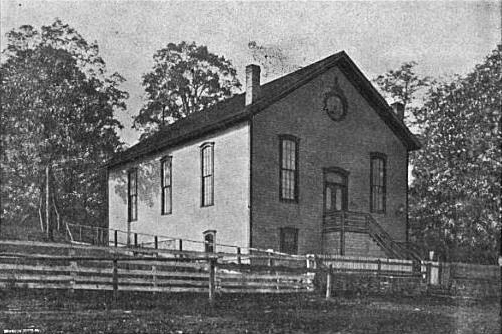
At the 40th anniversary service of Salina Reformed church, the following historical sketch was compiled by Dr. W. L. Fennell and read by the pastor, the Rev. Howard P. Loch:
The early settlers in Western Pennsylvania were mostly English speaking people: Irish, Scotch-Irish, and English. They were Presbyterians and Convenanters, differing In many details in church government and doctrine, but they were all followers of Calvin and Knox, used the same languages, style and forms of worship, and sang the Scotch version of the Psalms. The first churches were: Poke Run Presbyterian, 1789, Congruity Presbyterian 1790, and a Covenanter near North Washington. Many of the early settlers were Pennsylvania Dutch from Berks county, and Germans direct from Europe. These were Lutherans and Reformed; they sang the hymns of Luther and his followers, and understood the English language very imperfectly, so they had little inclination to join the English speaking people in worship. The nearest German speaking Lutheran and Reformed churches were: Brush Creek 1783, Harolds 1783, Greensburg 1796.
The county seat had changed from Hannastown to Greensburg in 1787. Allegheny had been made a county in 1788. Indiana County was still Manellan township. Armstrong county was still Armstrong township. Saltsburg and Apollo (Warren) were still unknown. Forts and blockhouses were much more in demand than churches. There were Fort Hand near Apollo, Fort Armstrong at Kittanning, Fort Green near the mouth of Crooked Creek, Fort Reed at Hannastown, Fort Craig near New Alexandria, Fort Crawford near Parnassus, and Carnahan’s Blockhouse at Perrysville. All of these were constructed between the years 1754 and 1790; after 1800 the Indiana caused little trouble, and the settlers planned to build school houses and churches.
The exact date of the first attempt to build a joint Reformed Lutheran church is not known, but was sometime between 1790 and 1800, Armstrong became a county in 1800, Indiana in 1803, Apollo was first laid out in 1816 and Saltsburg in the same year. An old town, on an abandoned Indian village on the west side of the river below Saltsburg made the high ground just south of what is now Avonmore a suitable central meeting place for the people on both sides of the river, and a good site to see any raiding bands of Indians which might come down the Loyalhanna trail and wish to cross the river and go north past Boiling Springs towards Kittanning. Of these first efforts to build a joint Reformed Lutheran church we have only traditions gathered 75 years later. The histories of both denominations give us records of ministers holding church services in this neighborhood before there was any church building but where they were held we can only guess. The history of the early preaching services held in this neighborhood by the Presbyterians before they had church buildings tells of holding them in barns, orchards, meadows, and school houses. Likely the Reformed and Lutherans were held In the same way Reformed and Lutheran being in the same language, coming from the same vicinity, having the same order of worship, attended these first services whether Reformed or Lutheran Indiscriminately. In fact, for many years after a church was built, the older people agreed that, except at communion services, there should be no distinction from one another. Almost all the direct branches of the old St. James were union churches up to 1860, The subject of a church was likely discussed at many meetings, log rollings, house raisings, harvesting bees as well as those far-between church services.
Sometime between 1790 ana 1600 Simon Hine, a Lutheran, donated for a church and graveyard a plot of ground on the river hill a-bout a half mile from where the main part of Avonmore now stands* Here the people gathered to erect a log church. It was customary in those days to have enough men and teams to cut down the trees, haul the logs to the ground while others erected the building complete, except probably the roof, doors and windows. The foundation, consisting of large stones for corners and supports, were laid quickly. Most of the timber was on the ground. They were just ready to place the sleepers for the floor, when someone raised the question "to whom shall the grounds and house be deeded?" The work stopped then, and there, and the building was never completed. The foundation and scattered logs were left there to rot. At the present, there are no traces of the foundation. However, the plot was used as a graveyard, the earliest being burled about 1805 and the last about 1900. The whole space is now covered with grass weeds and low bushes. This quarrel and failure stopped for many years the building of a union church, and neither side felt able to build alone*
Sometime between 1805 and 1812 Peter Yockey of the Reformed church agreed to donate a piece of ground where the old St James church, now stands. Tradition says that nearby there was already a school house. It is likely that the first church services and meet-Ings of the building committee were held In this school house. Here a log church was finally erect, the first in this immediately neighborhood. It was a union church. This constitution was dated Kay 8, 1815, the grounds surveyed October 10, 1815, and the deed dated December 5, 1815. It seems that the church was built a number of years before the article of agreement was made. This article of agreement was signed by 64 names, many of which are still plain enough to be read. The article was written In old Holland Dutch, and the names were signed In German script. Of these original charter members we are not certain that more than 16 were Reformed, about 26 were Lutheran, and about 20 were doubtful. Granting that the wives were also members would give us somewhere between 40 and 50 Reformed members. As to the building or size of this early church, we have little definite information. But it was probably similar to other nearest churches. The size of the church at Denmark Manor was 38 by 46 and Hills church 26 by 38. It was quite likely about the size of these. In 1838 the old log building was torn down and the present brick one erected. St. James is the mother of all the Reformed and Lutheran churches in this immediate neighborhood. Other churches were organized as follows: New Salem (Delmont) 1850, Fenneltown 1860, Pine Run 1862, Later Apollo and Vandergrift Reformed churches were organized, drawing many members from Pine Run.
The Reformed congregation at St. James was never as strong as the Lutheran. It had been weakened by deaths and withdrawals, and never had a resident pastor until 1874 when Rev. McConnell built in Salina. And by this time they were ready to abandon the old church and build at Salina, The good feeling and harmony between the two congregations no longer existed. The Sunday Schools did not work together. People attended only the worship of their own denomination. It seemed to the best interest of both to separate. The Lutherans were stronger and fewer of their members were desirous of leaving, the Reformeds were anxious to organize at Salina, so it seemed reasonable that the Reformeds should leave and go elsewhere. There was no church in Salina. The Presbyterians had proposed that if the Reformeds did not build in Salina they would. However if the Reformeds built they would not start a church in this town. So the question came to them, Why not sell their interest, organize and build in Salina when there was an opportunity to do both.
In 1868 there was organized a union Sunday School at Duffield's schoolhouse (the one Salina children attended). This Sunday School met on Sunday afternoons so as not to interfere with the attendance at other Sunday Schools or churches. This school was held regularly until the one at Salina was organized in 1877, Reverend McConnell began his pasorate at St James, Fennels, and Pine Run in 1974. He held occasional services at Duffleld's. It was hard to settle the question of the Reformeds leaving St James, some wanted to build one place, some another. However those living near Salina attended Sunday School and preaching at Duffield's. After several meetings at Duffield's it was decided on July 15, 1887, to organize at Salina, At the mouth of Wolford's run there stood the frame of an old saw mill erected by Israel Smeltzer. The lower story was used for a dwelling. The upper story was raised, windows put in and seated at an expense of about $300. In this hall Reverend McConnell preached the first time July 29,1877, and on the afternoon of the same Sunday a Sunday School was organized. The officers were: Superintendent S. P. Yockey, Assistant, Frank Smeltzer, Secretary J. D. Elwood, Treasurer Peter Whitesell, Librarian J. A. Barker, Chorister Y, X. McConnell. There were six teachers and 41 scholars. This school met every Sunday until October 10, 1860 when they lost permission to use the building.
A short time after the organization of the Sunday School, Salina Reformed Church was organized, on Saturday, September 22, 1887, by Reverend McConnell. There were 18 charter members: Simon P. Yockey, Margaret Yockey, Rachel McConnell, Sr., Peter Whitesell, Nancy Whitesell, David Willard, Susan Wlllard, Daniel Lauffer, Angeline Lauffer, Linus T. Yockey, Margaret M. Yockey, Y. X. McConnell, Rachel McConnell, Rebecca Elwood, John M. Yockey, Rachel Caldwell. The following officers were elected all to serve for two years: Elders, I. T. Yockey, David Vfillard; deacon, S. P, Yockey. On the following Sunday R. J. Caldwell, Sarah M. Lucas, Israel Smeltzer, Margaret Smeltzer, Nancy B. Elwood and Mary Elwood were added. On March 9, 1878, James Elwood J. Franklin Whitesell, Harry Whitesell, Laura Belle Whitesell, Martha Carnahan, and George Elwood were added. On August 29, 1879, Martha J. Slusser, Rebecca Elwood, John Johnston, Anna Shay, Sarah E. Sipes. These were all the names recorded prior to March 14, 1886, when the present church was dedicated. Rev. McConnell was appointed supply for St. James, Salina, Zions Valley and serve these churches until October 10, 1880. At that time there was some difficulty in raising the pastor’s salary. For a time, Salina and St James were supplied by Reverend Good, of Delmont. In the meantime, Salina congregation had lost possession of the hall and had no place to hold church or Sunday School, so the people of Salina had to go to St James.
In May, 1882, Rev. A. A. Black became pastor of Delmont, St. James and Fennells. In the spring of 1884, he reorganized the Salina congregation and held services at Duffield's school-house. They elected new officers and appointed a committee to select a site for a church at Salina and solicit subscriptions. This committee succeeded in getting subscriptions for $1,100, but failed to get a suitable location on which to build, and again the whole project fell through.
At the annual meeting of Westmoreland Classis in 1885, a committee of three was appointed to visit Salina and assist in building a church. Rev’s. Snyder, Truxal, and Kenner came to Salina and held a meeting July first, 1885. Two committees were appointed to solicit subscriptions: S. P. Yockey, I.X. McConnell, J. P. Whitesell, T. M. Willard, John Muffley, Peter Whitesell, and S. H. Yockey. This committee proceeded to build on a lot where the church now is, procured, from Rev, McConnell for $150.00, size of lot 45 x 90. When later additions were made to the church further leases were procured: 10 feet, the length of the lot behind the church, and 1 x 20 feet where the tower now stands. In 1914 the lot adjoining the east side 60 x 90 feet was bought from Mrs. Nora Ewing for $300.00.
The corner stone of the church was laid September 30, 1885. The services were held in a grove on the adjoining lot. The building was erected 34 feet wide, 50 feet long, 16 feet high with a recess behind the pulpit, 5 x 10 feet. The church was heated by two large jacked stoves in the basement; it was lighted by a central chandelier of 24 lamps, 8 side lamps and two pulpit lamps. It was wainscoated 4 feet high and the rest plastered. At first the seats were chairs. In 1898 these chairs were changed for the present pews. A congregational meeting was held on Saturday, March 13, 1886. New officers were elected. On the following day Sunday, March 14, the church was dedicated with the following ministers present: McConnell, Snyder, Truxal, Black, Diffenbaugher, and Andrews. Seventeen new members were added to the church, roll on dedication day. A Sunday School was also organized, with an enrollment of 70 scholars. During the pastorate of Rev. Andrews, 40 new names were added to the roll. Rev. Andrews preached his last sermon on Feb. 26, 1888. Frank Lauffer preached at Salina and St James every other Sunday from June 1st to September 16 of this year, at which time he was ordained and installed as pastor of Salina and St James at a salary of $ 500.00,
Rev. Lauffer resigned May 1st, 1893. During his pastorate 36 names were added to the church roll, making the number of members 120. Again, Salina and St James were united with Pine Run as a charge with Rev. 0. Y, Summey as pastor. He took charge July 1, 1893.
Westmoreland Classis held its annual meeting at Salina May 29, to June 3, 1895. Two years later, 1897, all services at St. James were discontinued because of failure of members to attend or pay. And in June, 1898, Summey resigned. Rev. W. S. Fisher became pastor of Salina and Pine Run in 1899, each congregation agreeing to pay him $ 350.00, In 1902 the parsonage was built.
In the spring of 1904, the Salina bridge was carried away by the ice, making it difficult for those on the other side of the river to attend Sunday School and Church in Salina, Then a Sunday School was organized in Edmon meeting in the Edmon school house and holding Sunday School and Church every Sunday afternoon, until about 1910, after the new bridge was built. The 1910 report gives the Sunday School reports as follows: Officers and teachers 10, scholars 32, contributions $ 45,33. The young people’s society had an average attendance of 50 and the total contribution reached $ 51.50,
For a number of years an afternoon Sunday School was conducted in Tintown by Miss. Alice Learn, In 1920 the report gives an enrollment of 90 and an average attendance of 60, This school was almost entirely the work of one person, and when she ceased to be able to attend , it stopped. After the Reformed Church ceased having services in Edmon, then General Council Lutheran Church commenced having preaching, and organized there but they succeeded so poorly that they soon disbanded.
Dates of organization: Christian Endeavor, April 29, 1892. Intermediate C. E., 1917. Junior C. E., October 19, 1894. Brothers in Christ, April 29, 1915. Hoem Department, 1914. Cradle Roll, 1914. Ladies’ Aid Society, Feb. 27, 1917. Women’s Missionary, 1890.
The Consistory at the first was composed of two elders and one deacon; now it is composed of six elders and six deacons, Since 1903 there have been three trustees to look after the church property, And since 1916 there have been six deaconesses to look after the sick and needy. The membership has grown from the original 18 charter members till now it numbers 461. The contributions have also increased greatly, from a very small amount, to last year when the church contributions passed the $5,000.mark, the amount was $5,190. And if we add the contributions of all organizations the total for 1925 is $6,459.77. In addition there is a building fund on hand totaling $3,329.19.
The current church building was constructed in 1977. The fellowship hall across the driveway was completed in 2026.
Pastors of Salina Bible Church
- John McConnell 1877-1880
- A.A. Black 1880-1884
- W. M. Andrews 1886-1888
- J.F. Snyder 1888-1889
- F.E. Lauffer 1889-1893
- C. W. Summey 1893-1898
- Will S. Fisher 1899-1901
- J.F. Snyder 1902-1912
- Vincent Hartman 1913-1922
- Henry E. Gebhard 1923-1924
- Howard F. Loch 1924-1929
- C.L. Bash 1929-1932
- Clarence B. Hower 1933-1946
- D.C. Book 1946-1947
- D.O. Slyter 1953-1957
- C.E. Bentley 1964-1979
- Paul R. Nitz 1980-1986
- John E. Collins 1987-1991
- Paul M. Reiner 1991- 2026